Fixed-scope engagement
AI Guardrails
Your teams are adopting AI faster than anyone can supervise it. We put real, enforced limits around what data can go to which AI tools, and what it can cost — so you get the speed without the exposure.
Tell us what’s going onAt a glance
- Best for
- AI adoption moving faster than platform controls
- Scope
- Models, data classes, access paths, usage, and spend
- Working shape
- A fixed-scope guardrail build
- Main result
- A safe path teams can use without bypassing policy
The problem AI governance guardrails solve
Common situation: teams are wiring up LLMs faster than anyone can set policy, so data flows are unclear, spend is untracked, and shadow usage grows. Root cause: AI adoption outran platform controls; governance bought as external SaaS or slideware doesn't enforce anything inside your accounts, doesn't survive the subscription, and leaves the data-flow and spend risk live.
Why this isn’t governance-SaaS or slideware
A rented dashboard observes; it rarely enforces, and when you stop paying, the control leaves with it. A consultancy framework tells you what good looks like and bills you to be told. We build the guardrails as policy-as-code and infrastructure inside your own accounts — so the enforcement is real, it's auditable, it keeps working after we're gone, and it's yours to change as the models and your needs change.
What you own when we leave
- A paved-path module: Terraform/IaC for sanctioned model access (managed-model access patterns, gateways, key handling) that teams consume instead of going around.
- Policy-as-code guardrails: which models, which data classifications, allowed regions, spend/rate limits, logging of usage where appropriate — enforced, in your repo.
- A data-flow threat model for AI usage (what data can reach which model, and the boundaries that stop the rest).
- Cost and usage visibility/controls as code.
- ADRs for the model-access and data-boundary decisions, and runbooks for sanctioning a new model or use case.
Not just an "AI governance strategy" document. We'll happily write the document too — it just arrives with the guardrails already enforcing it.
How we approach it
- 01
Discovery
We read your accounts, configs, and constraints directly (scoped read-only access or exported state), map the real current state, and agree on a written scope and success criteria before any code is written.
- 02
Architecture Decision Records
We write down the key decisions — what we’re doing, the options we rejected, and why — as ADRs in your repo, so the reasoning survives long after we’re gone and you can challenge it before we build.
- 03
Implementation
We build the solution as reviewable Terraform/IaC in small, tested pull requests against your CI, so you watch it land incrementally and nothing arrives as a black box.
- 04
Handover
We walk your team through the repo, the threat model, and the runbooks live, confirm you can apply/destroy/extend it yourselves, and then we leave. You own everything — there is no phase 5 where you still need us.
Engagement shape
A fixed-scope build over your AI/cloud platform, delivered as a consumable paved-path module plus enforced policy-as-code and a live handover. Scope is set by your cloud, the model-access patterns in play, and the policies you need enforced — agreed up front.
Fixed price, agreed in writing before we start. You can stop at the decision point and keep everything produced.
- 30-day warranty: anything we shipped that does not behave as documented, we fix at no charge.
- Discovery normally uses scoped, read-only roles you create and can revoke; data handling is agreed before access.
- A Senior Engineering Block is available afterward if the next backlog is better handled as flexible hours.
Read a sample deliverable
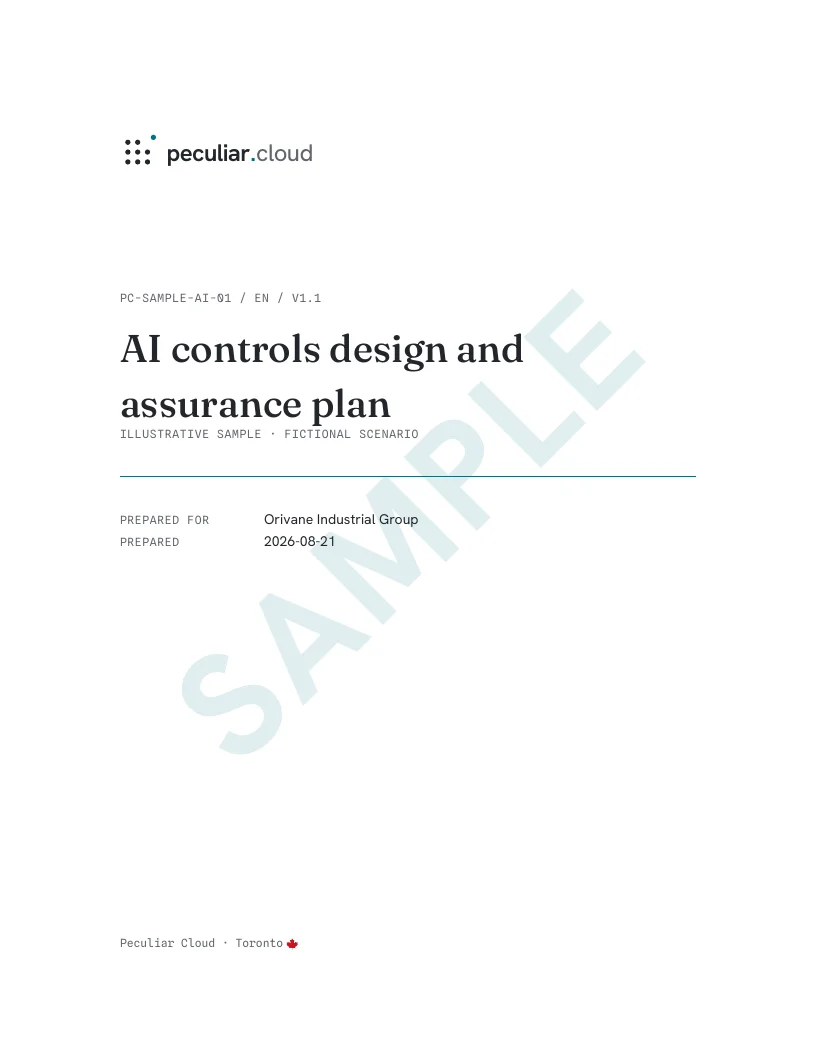
Sample report
AI controls design and assurance plan
12 teams · 8 AI applications · 4 model services
An AI control plan covering permitted data, approved models, action permissions, budget limits, release tests and operating responsibilities.
An original illustrative scenario. No client material or engagement results.
FAQ
Questions about this engagement
What do I actually get — is this just a report?
No. Build engagements end with infrastructure-as-code in your repository: Terraform/IaC, the guardrail set (Service Control Policies or equivalents), a threat model, ADRs, and runbooks. The documents exist to help an engineer run the code — they are never a substitute for the working change. Code you own, not slides. The live software, illustrative technical formats, and public repositories on this site show how we document and build.
Why not just use a CSPM/governance SaaS or a Big-4 firm?
A SaaS dashboard observes and alerts; it rarely enforces inside your accounts, and the control leaves when the subscription does. A Big-4 engagement often ends in a framework and a recommendation to hire builders. We build the enforcing controls as code you keep. Different tools have their place — but if you want enforcement you own, that is specifically what we do.
What if something breaks after you’ve handed over and left?
Work we ship includes a 30-day warranty: if it does not behave as documented, we fix it at no charge — that is a defect, not new scope or time deducted from an Engineering Block. The code and documentation use standard tools your team or another engineer can maintain. If you want us back, the follow-on can be another defined project or a prepaid block of hours.
Can we keep you around after the engagement?
Yes. A Senior Engineering Block is a prepaid pool of hours for agreed investigations, reviews, changes, debugging, questions, or small pieces of implementation. It can follow a project or stand on its own. It is not a subscription, managed-service retainer, or emergency on-call service. Hands-on training is also available on your real environment rather than generic courseware. Neither is required; project handovers are designed so your team can run the result without us.
We already have a security team / platform team. Why bring you in?
Usually because they are at capacity, or the work needs a specific senior depth (landing-zone design, zero-trust enforcement, hybrid routing, AI guardrails) that is hard to staff for a one-time build. We work as reviewable PRs against your CI so your team reviews and absorbs everything as it lands — by handover it is genuinely theirs, not a black box dropped on them.
What access do you need, and how do you handle our data and credentials?
Discovery normally uses scoped, read-only IAM roles that you create and can revoke — not long-lived keys handed to us. Where possible, implementation runs inside your tenancy and CI. Any exports, working copies, retention, deletion, data location, and required service providers are scoped for the engagement and agreed before access is granted. You can inspect the public site too: cookie-free self-hosted analytics, a clean CSP, no session replay, and no advertising trackers.