Fixed-scope engagement
Cloud Foundation Build
You're building on the cloud — or outgrew the setup you started with — and want it done properly this time: secure, organized, and ready for new teams and products. We build that foundation and hand it to your team, fully documented, theirs to run.
Tell us what’s going onAt a glance
- Best for
- A cloud setup that needs a durable foundation
- Scope
- Accounts, identity, network, logging, and guardrails
- Working shape
- A phased, fixed-scope build
- Main result
- A secure foundation ready for teams to use
The problem an AWS landing zone solves
Common situation: the company started in one account, grew quickly, and now every team negotiates security from scratch while much of the setup is still clicked in by hand. Root cause: no account-vending or guardrail baseline means security is per-team tribal effort and drift is unbounded; hand-built consoles can't be reviewed, reproduced, or audited.
What you own when we leave
- A Terraform/IaC monorepo (or modules) for your org/account structure — multi-account on AWS, multi-cloud where in scope — with an account-vending/baseline pattern your team applies to create new accounts.
- A guardrail set (Service Control Policies on AWS, equivalent org policies on other clouds) enforcing your non-negotiables by default.
- Centralized identity wiring (SSO/IdP federation, baseline roles, least-privilege patterns).
- Baseline network and connectivity scaffolding (VPC/segmentation patterns, shared services).
- Centralized logging, audit, and guardrail-violation visibility, as code.
- An ADR log capturing the structure decisions, and runbooks for vending accounts, changing guardrails, and break-glass.
Not a reference architecture diagram you then pay someone else to implement. The foundation is running, in your accounts, defined in your repo.
How we approach it
- 01
Discovery
We read your accounts, configs, and constraints directly (scoped read-only access or exported state), map the real current state, and agree on a written scope and success criteria before any code is written.
- 02
Architecture Decision Records
We write down the key decisions — what we’re doing, the options we rejected, and why — as ADRs in your repo, so the reasoning survives long after we’re gone and you can challenge it before we build.
- 03
Implementation
We build the solution as reviewable Terraform/IaC in small, tested pull requests against your CI, so you watch it land incrementally and nothing arrives as a black box.
- 04
Handover
We walk your team through the repo, the threat model, and the runbooks live, confirm you can apply/destroy/extend it yourselves, and then we leave. You own everything — there is no phase 5 where you still need us.
Engagement shape
A fixed-scope build over a defined cloud footprint and account model, delivered as reviewable Terraform PRs and ended with a live handover. Scope is set by your cloud count, account model, and guardrail strictness, all agreed in writing first.
Fixed price, agreed in writing before we start. You can stop at the decision point and keep everything produced.
- 30-day warranty: anything we shipped that does not behave as documented, we fix at no charge.
- Discovery normally uses scoped, read-only roles you create and can revoke; data handling is agreed before access.
- A Senior Engineering Block is available afterward if the next backlog is better handled as flexible hours.
Read a sample deliverable
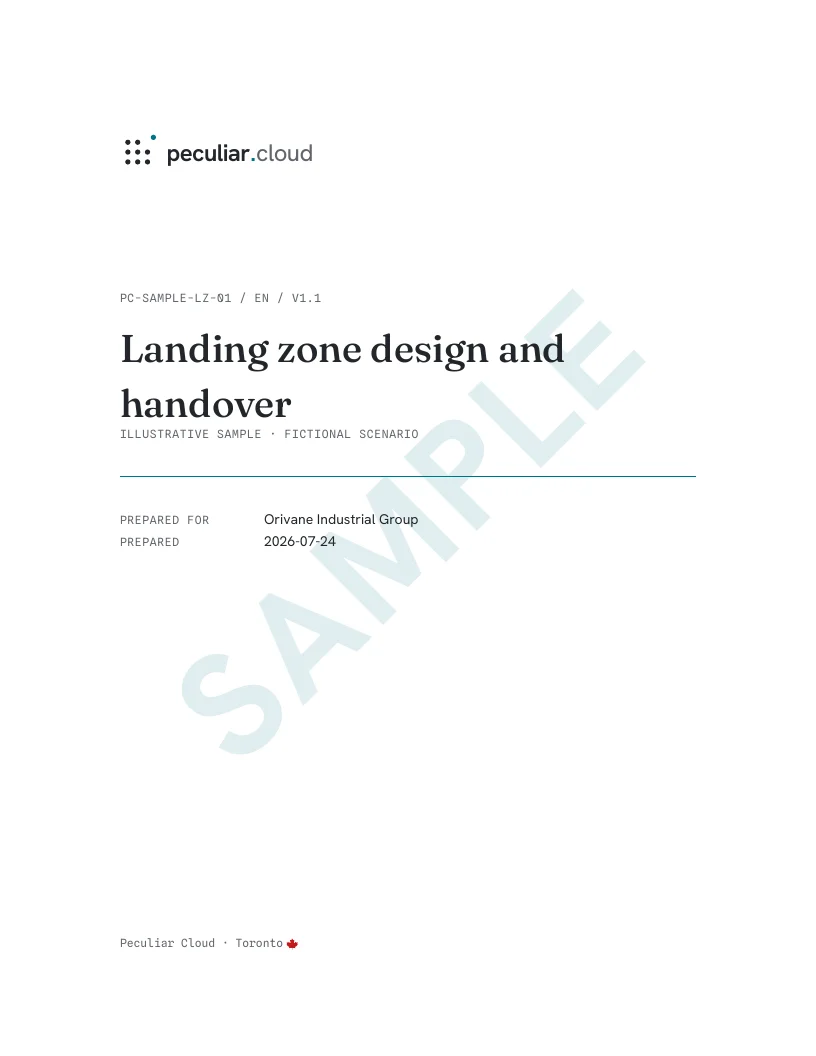
Sample report
Landing zone design and handover
48 accounts · 24 workloads · 3 migration waves
A plan for building and operating a shared cloud platform: accounts, access, networking, security rules, migration stages and handover checks.
An original illustrative scenario. No client material or engagement results.
FAQ
Questions about this engagement
What do I actually get — is this just a report?
No. Build engagements end with infrastructure-as-code in your repository: Terraform/IaC, the guardrail set (Service Control Policies or equivalents), a threat model, ADRs, and runbooks. The documents exist to help an engineer run the code — they are never a substitute for the working change. Code you own, not slides. The live software, illustrative technical formats, and public repositories on this site show how we document and build.
What if something breaks after you’ve handed over and left?
Work we ship includes a 30-day warranty: if it does not behave as documented, we fix it at no charge — that is a defect, not new scope or time deducted from an Engineering Block. The code and documentation use standard tools your team or another engineer can maintain. If you want us back, the follow-on can be another defined project or a prepaid block of hours.
Can we keep you around after the engagement?
Yes. A Senior Engineering Block is a prepaid pool of hours for agreed investigations, reviews, changes, debugging, questions, or small pieces of implementation. It can follow a project or stand on its own. It is not a subscription, managed-service retainer, or emergency on-call service. Hands-on training is also available on your real environment rather than generic courseware. Neither is required; project handovers are designed so your team can run the result without us.
We already have a security team / platform team. Why bring you in?
Usually because they are at capacity, or the work needs a specific senior depth (landing-zone design, zero-trust enforcement, hybrid routing, AI guardrails) that is hard to staff for a one-time build. We work as reviewable PRs against your CI so your team reviews and absorbs everything as it lands — by handover it is genuinely theirs, not a black box dropped on them.
What access do you need, and how do you handle our data and credentials?
Discovery normally uses scoped, read-only IAM roles that you create and can revoke — not long-lived keys handed to us. Where possible, implementation runs inside your tenancy and CI. Any exports, working copies, retention, deletion, data location, and required service providers are scoped for the engagement and agreed before access is granted. You can inspect the public site too: cookie-free self-hosted analytics, a clean CSP, no session replay, and no advertising trackers.